Breaking

Digi Ads Launching Soon

Search This Blog

March 10, 2020

As Cookies Disappear, Omnicom Media Group Rethinks Context And Attention

As Cookies Disappear, Omnicom Media Group Rethinks Context And Attention


Omnicom Media Group is already rethinking how to monetize attention, in light of Google’s decision to remove third-party cookies from Chrome in two years.
“We are starting to push clients to think about attention as dynamic and be more considerate in how we activate against it,” said OMG CEO Scott Hagedorn.
But rethinking customer attention isn’t just necessary in environments that use cookies. Reaching someone on TV, for example, is different than advertising on Facebook, because people are in completely different mindsets during those experiences. Context should factor more heavily into the buying equation – and losing access to cookies may help reassert that balance.
OMG is bringing this shift in thinking around attention to the upfront this year, where it’s eager to transact against new currencies that more accurately reflect the way people are consuming TV today.
But the biggest challenge is changing the way TV buyers are used to transacting, as well as getting clients to adopt new payment models that allow agencies to change the way they execute.
“The hardest thing is changing the service model to adapt to technology,” Hagedorn said.
Hagedorn and John Swift, Omnicom Media Group’s COO in North America, spoke with AdExchanger.

AdExchanger: How is OMG reconciling the loss of third-party cookies?
SCOTT HAGEDORN: The cookie world was built to deliver a dynamic digital experience in a TV-like format on desktop. If we can cookie somebody, we know what they’re into. We can serve them an ad based on what we think they need to see. We can dynamically render it. The whole industry has been chasing that for 20 years.
What did that miss? Mobile, apps, identity. With cookies deprecated, all those investments – and we’ve made bets in the past, like on DMPs – are out the window. If we’re in the business of persuasion, how do you do it in an appropriate way?
Can audience targeting still exist in an “appropriate way”?
JOHN SWIFT: The more personal the experience, the narrower the boundaries are for the brand. That’s the challenge we’re going through with social. [We’re trying to] stop thinking about channels and digital silos and more about content and experiences.
SH: It’s somewhat counterintuitive that our clients that [want] to do more dynamic marketing only want to buy television and outdoor. They are pushing the industry forward on one-to-one marketing, but they don’t spend their money in those spaces. So we have to live in this parallel world of demographics and behavioral and try to reconcile those two spheres.
How is OMG tackling cross-channel measurement as cookies disappear and more walled gardens emerge?
SH: We’re working on relinking media and brand equity. We divorced content from context and started talking in terms of video neutrality. But if you’re Mercedes Benz, rubbing shoulders with Jon Hamm in “Mad Men” is not the same as rubbing shoulders with PewDiePie.
JS: Context matters. We lost track of that in the promise of a fully digitized media experience. Connected TV is probably the final frontier to bring premium content into one place as opposed to, “this is my digital bucket.” The TV bucket is now part of the digital bucket.
How is that convergence impacting your approach to the upfront this year?
SH: Publishers are as desperate as we are to move away from the broken clock of measurement that currently exists. They realize their content is being consumed in totally different ways. Even if they were to try to install technology, the measurement doesn’t work.
For a lot of publishers, [linear declines are] made up for in streaming or on demand. It’s insane that we can talk about ratings and not [include] Netflix. Ratings are about attention. How are these things completely excluded from the currency of attention?
How do you get TV buyers and clients to embrace new ways of measuring attention?
SH: How do you turn the largest media agency in the world into a cross-screen delivery department that’s never existed before?
Investing in the tech is almost easier than changing the client relationship and renegotiating what the team looks like. There’s some reticence because it could trigger a review or something. But being bold enough to say that is really important.
JS: We have to start measuring value in a more multidimensional way than just price. Consultancies aren’t selling themselves out by the hour like we do. Clients are open to conversations around how we charge for outputs and outcomes as opposed to just how much does it cost and how many hours did you work?
What business models are clients willing to try? 
JS: Performance was limited to digital channels and that’s where CTV comes in. A performance-based mindset is something we’ve infused through all of our agencies, which is a good place to start. But we’ve been kind of hamstrung.
SH: There’s an imbalance on scoping what it takes to get it done. How do we present the fully loaded business case in a rational manor?
In two years, I predict our total number of FTEs will be smaller and we will monetize the applications we’ve developed on a variable basis, almost like ad serving. That’s our IP. The hard thing for us as a talent business historically is making the jump into monetizing the investments we’ve made in technology and software. We have to make the leap to monetizing our IP.
March 10, 2020

First-Party Consent Can Replace Third-Party Cookies

First-Party Consent Can Replace Third-Party Cookies


“Data-Driven Thinking” is written by members of the media community and contains fresh ideas on the digital revolution in media.
Today's column is written by Manny Puentes, founder and CEO at Rebel AI.
Google’s recent decision to deprecate third-party cookies on Chrome will severely cripple browser-based targeting, cross-site tracking, frequency capping and retargeting. Ad platforms will be blind outside of the contextual attributes passed in any opportunity to serve an ad.
Third-party cookies have been an anonymous, necessary evil to deliver highly targeted ads. Though third-party cookies are discussed in terms of consumer privacy, the third-party cookie itself is actually completely anonymous. Platforms can’t determine who you are based on the generated ID representing your device. Real privacy concerns start to proliferate when you mix third-party cookies with form data, such as email, first name and last name, and send that data along with a cookie.
If you extrapolate this use case and allow for that same ID to persist from site to site, data platforms can get smarter about your behavior and interests.

Email won’t save us
Any ID, cookie or otherwise, that can eventually be tied to form-data/PII will become a privacy issue. In light of the coming changes to Chrome, some companies have announced they will use email or other types of identifiers to replace some of the consumer targeting that will be lost.
Some platforms are proposing email as the Rosetta stone to “anonymously” identify the consumer. Let’s take cross-site tracking as an example. If platforms are left with first-party cookies, all of the data will be siloed by site. That means the consumer will have a different first-party cookie ID from site to site as they surf the internet. In this new paradigm, email will be used as the key to stitch the data together to reveal behavior and interests, same as before, except with strong standardized joining criteria for offline data.

Email represents another ID tied to the consumer vs. the device, and is even more intrusive. With this change, consumers can further be tied to offline data, such as home refinancing applications or store visits if they gave their email to receive digital receipts.
Yes, I know it’s hashed and “anonymous,” and can’t be reverse-engineered. But an entity with raw consumer data and consumer emails can continue to link form-data/PII, therefore identifying the consumer all over again.
The problem isn’t a technical one. The industry will eventually figure out a way to technically track consumers. The real challenge is abiding by the emerging policy, legislation and regulation requirements that dictate what consumer data companies can and cannot collect.
The consent solution

Sites are highly dependent on the first-party cookie, and as the industry transitions to using first-party cookies to target advertising, consent becomes a more controllable asset. This is a new opportunity for consent platforms to provide the gateway to ensure that the needs of consumers and the ad ecosystem are met.
Consent platforms have come a long way in establishing a strong foundation to protect the consumer. As an industry, we are finally giving consumers the ability and opportunity to not be tracked.
In tandem with these platforms, there’s technically still a way to use first-party cookies for cross-site tracking, frequency capping, targeting and retargeting without the need of a hashed email to keep the ID anonymous without using PII.
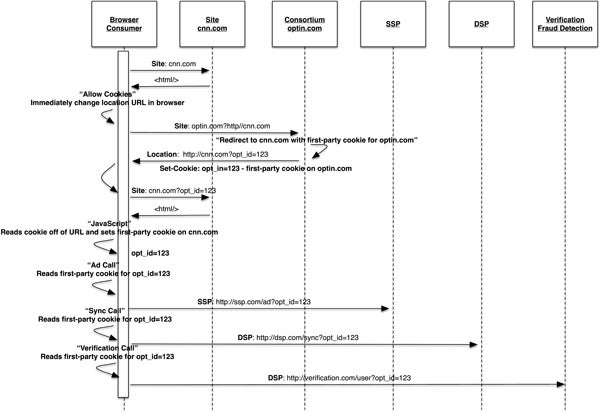
Let’s say I browse to cnn.com, receive a prompt to allow cookies, and I hit “Allow.” If the consent platform took the “cnn.com” location in the browser and reset the location to point to “optin.com?url=http://cnn.com,” it would allow a first-party cookie to be set on “optin.com.” If optin.com would immediately redirect back with “http://cnn.com?optin_id=123,” it would allow for the first-party cookie to be read off of the URL set on “cnn.com” with the key of “opt_in” and the value of 123.
This technical workflow would allow for subsequent calls, if they had JavaScript on cnn.com to query for “opt_in” and pass the value to ad platforms on the URL, along with any metadata appended as a query string parameter to reenable targeting and cross-site tracking. The redirect in this use case, after you hit “Allow,” would give back the same ID on “optin.com” any time the consumer allows cookies for tracking.
Click here to enlarge graphic.
For this to work, standards and specifications will be paramount, and the IAB must play a crucial role in standardizing the first-party cookie workflow outlined above. For example, we would need the key for the first-party cookie to retain a unique standardized name so that platforms that are interested in passing the ID (opt_id=123) know what key to query on the first-party cookie.
An open consortium would also be needed to manage and own the “optin.com” domain, the services required to apply the redirect and the open-sourced JavaScript to set first-party cookies off of the URL to later be queried by other platforms.
The aforementioned workflow would only activate after hitting “Allow Cookies” on a consent platform. As you can see, the ecosystem would share the same ID when targeting and tracking, granting the consumer more control over consent and providing the road map for a safer consumer experience.
There will always be a workaround to track the consumer. While the industry is fretting about the death of the third-party cookie, the real problem is not a technical one. The issue remains what we are legally able to collect on the consumer while adhering to evolving standards surrounding consent and privacy.
We should also be looking at the data that Facebook and Google are collecting. In-home devices, Gmail, Google Documents, Google Maps, Search and Google Apps are all collecting data on a first-party basis, and killing the third-party cookie will do absolutely nothing to stop them from collecting data and monopolizing the advertising market. In fact, it’s empowered their initiatives.
I’m optimistic about the long-term opportunities that this change heralds. The third-party cookie was messy for reasons not related to privacy. Though Google and other industry giants have given themselves an advantage, this change will spur the rest of the industry to innovate, creating new solutions to compensate for the changing environment. The death of the third-party cookie truly empowers us all to come together and build a seamless environment that adheres to privacy controls managed by one ID that represents a consumer and their consent.
March 10, 2020

Third Party Cookie Dead? Now what

As the cookie collapses and regulation chokes the digital ecosystem, brands need to plan ahead


The crumbling cookie, the privacy protection push, the rising regulations – digital marketing ecosystem is witnessing an age of upheaval.

The woke global consumer, aided by regulations such as GDPR and CCPA, wants the control back. Tracking consent, opt-in, opt-out, right to be forgotten and the list goes on… Suddenly, the usually very proactive data and digital ecosystem has gone into a reaction mode. Tech giants and data providers are revisiting their data policies and brands struggling to ensure compliance of their existing tech stacks.

As always, India is never far behind in following the trends. The implications of changes brought about by the global tech providers are already being felt. That coupled with our homegrown PDP (Personal Data Protection Bill) necessitates brands and marketers to sit up and notice. But before we throw the baby out with the bathwater, the question is – Will India be a different story?

Yes, it will be. Sometimes, not being as evolved as the western world is a boon in disguise. India by and large is still in its infancy when it comes to data driven marketing. Other than the large global brands with centralized data and tech infrastructure, the rest can be counted on fingers quite literally. Therefore, unlike the evolved markets we don’t have to go back to the drawing board and reinvent completely. We can simply plan ahead and change trajectory.

So how can Indian brands plan ahead and change trajectory? Is there a ready reckoner so far? Unfortunately, there is a lot of jargon doing rounds that overwhelms and confuses rather than help. At GroupM Motivator, we believe in simplifying the complex for emerging brands. Here are the key implications that Indian brands need to be aware of and plan for.

1. The Strengthening Of The Walled Gardens – There was a time when data driven marketing meant breaking down of the silos. Today the scenario stands reversed. The need to be compliant is driving the giants such as Google, Facebook and several other large publisher networks to further strengthen the walls. The implication is not just for cross platform media buying, tracking and optimizing, but for brands wanting to invest in tech stacks as well.

2. The Break In Attribution Journey – The single view of consumer and end to end digital consumer journey attribution will become a distant reality. The walled gardens and the demise of the cookie will make it increasingly difficult in a cross platform, cross screen environment. Therefore, marketers need to be very wary of promising El dorado.

3. The Deepening Divide By Publisher Size – The bigger publishers and networks with massive own data and ability to target intelligently will benefit, at least in the short term. On the other hand, the value of inventory from smaller publishers will go down. This will in turn impact the brand’s media mix and money outflow by network.
Needless to say, a few of the above may be short term and will be overcome as the ecosystem finds stable alternatives. While that happens, brands will have to plan ahead. Here are the imperatives that are likely to shape the future of digital marketing.

4. The Rise Of Owned Assets – Sadly, most brands in India are underleveraging their own media massively. While the websites exist, the core objective currently doesn’t go beyond information dissemination and landing traffic from paid media campaigns. Now with first party data becoming the most valid, compliant data available to brands, the owned assets will rise to power. The brand website are the new data farming hubs. However, in order to truly leverage the power of owned media, brands need to invest in both a compelling UI/UX and interactive triggers for consumers to leave behind data in exchange of value of some kind.

5. The Consolidation Of The Stack – As walls become stronger and compliance becomes a key concern, brands will tend to make safer choices. It will increasingly make more sense for brands to invest in stacks from a single technology provider rather than customize a mixed bag.

6. The Resurgence Of Digital Creative – The heightened focus on performance and targeting had gradually led to digital creative becoming an ancillary service in digital marketing. Now is the time for creativity to make a comeback. There are two clear implications visible.

a. With limited opportunities to reach the intended TG through paid efficiently, brands will have to find ways to bring the TG to the communication. The onus of giving organic legs to the brand communication will again have to be shouldered by compelling creative and content.

b. For targetable audiences, to make best use of data, the focus on non-intrusive customization will go up. These seem like chaotic times for the digital media industry. But as they say, every wave of new technology that changes the world is followed by regulation. Time for brands to ride the wave and emerge winners.
March 10, 2020

Walmart Launches Self-Serve Ad Platform

Walmart Launches Self-Serve Ad Platform, But Retail And Audience Data Isn’t Available – Yet


Walmart claims its programmatic advertising platform and ads API are ready for primetime.
On Friday, Walmart Media Group (WMG), the retail giant’s advertising arm, released a self-serve portal so advertisers can directly buy on-site search and sponsored product ads on walmart.com.
It also launched an API to make that inventory available through Teikametrics, Flywheel Digital, Kenshoo and Pacvue, who were all API test partners.
Previously, advertisers and sellers were only able to purchase search ads and sponsored product placements on Walmart as part of a managed service buy.
Lex Josephs, VP of sales and media partnerships for WMG, said in a blog post that the partnerships let Walmart “meet the needs of advertisers.”
The tools were in beta since late last year, when it was first reported by Business Insider that Walmart was cooking up solutions to compete with Amazon.

If Walmart really wants to compete with Amazon, however, it needs to avail its unique retail and audience-level data – which for the moment isn’t available for ad targeting. Sources tell AdExchanger that Walmart Media Group’s new product primarily lets advertisers bid for keywords to position their ads at the top of a Walmart search results page.
But Walmart’s retail data, and the ability to attribute online search activity to in-store sales, would be a huge advantage for Walmart over Amazon. Ninety-percent of Americans shop at a Walmart every year and nearly 160 million people visit its stores and sites on a weekly basis.
"Walmart's most pressing advantage in ecommerce advertising is its offline experience and scale," said Nich Weinheimer, GM of ecommerce at Kenshoo. "Other ecommerce players, like Amazon, have been working hard to figure out how to measure the impact of their advertising on offline sales – for Walmart Media Group, the omnichannel customer continuity is already there."
Even in terms of reporting, Walmart is a closed-loop ecosystem and advertisers only get minimal info, such as visibility into performance by device type and insight into the frequency of searches. Walmart also provides some intel to map site search to in-store sales, although it’s early days on that front.
But advertisers are still chomping at the bit to spend with Walmart, partially to diversify spend away from Amazon.
“There’s massive interest in this platform being successful,” said John Shea, chief growth officer at Teikametrics. “The brands we work with want to activate more dollars on walmart.com than they’re currently able to spend, and they’re really excited about companies being able to plug in to enable that opportunity for them.”
Teikametrics already has “dozens” of clients actively buying sponsored product ads via the API, and, when they do, they’re able to generate an average of 30% more revenue per click.
It’s also noteworthy that the majority (around 85%) of orders that Teikametrics drives through Walmart sponsored ads come from non-branded search queries. In other words, searches from people looking for categories rather than specific brands, which means advertisers can use walmart.com to help drive visibility and awareness through product discovery.
“They are working to catch up to the more mature advertising platforms, like Amazon, Google and Facebook,” Shea said, “but Walmart has a sharp understanding of what brands want, they’re listening to brands and they have an opportunity to build something meaningful here.”
Over the past year, Walmart has been getting serious about bringing more of its media efforts and buy-side operation in house. Walmart ended its long-term relationship with retail agency Triad in February 2019 and acquired Polymorph Labs, which has a cloud-based ad serving platform, in April.
March 10, 2020

Amazon Challenges Google and Facebook hold on Digital Ad Market

AMAZON CHALLENGES GOOGLE AND FACEBOOK'S HOLD ON DIGITAL AD MARKET


Ad spending growth hits the pause button. Facebook, Google and other tech giants find themselves in more hot water. Marketers struggle with stricter government regulations regarding data privacy. These are just a few of the predictions that Ad Age Studio 30 made in January in its annual trend report, “2019 Forecast: The Year Ahead.”
So which of those prognostications came to pass—and which were off the mark? You be the judge. Here are five major predictions from last January's trend report and the events that followed.
Prediction: Global ad spending will see slower growth due to a lack of cyclical events and general economic uncertainty. The three major ad forecasters predict an average increase in spending of about 4 percent, citing potential weakness in the global economy due to factors including Chinese growth and looming trade wars.
What happened: Ad spending forecasts were generally on target. According to a report from GroupM, global advertising (excluding U.S. political advertising) will end this year with 4.8 percent growth, down from 5.7 percent in 2018. Throughout 2019, U.S. imposed tariffs and trade talks with China temporarily blunted markets and hampered some sectors of the U.S. economy, but conditions generally rebounded. Forecasters are now weighing the impact of spending for cyclical events (Olympics, the U.S. election) in 2020.
Prediction: Digital ad growth will remain strong, but is expected to slow into the single digits by 2021.
What happened: The slowdown has begun, but is perhaps not as pronounced as some forecasters were expecting. According to a new report from Magna, U.S. spending on digital advertising is expected to grow 16.1 percent this year (down slightly from 17 percent in 2018) and 10.9 percent in 2020. And eMarketer now says that the growth of global digital spending will remain in double digits for the next three years, eventually sliding from 10 percent in 2022 to 8 percent in 2023.


Prediction: Amazon will siphon more ad dollars from Facebook and Google, potentially threatening to break up the digital ad duopoly.
What happened: Amazon remains a distant third in overall digital ad revenues behind Google and Facebook, but its search advertising business is a growing threat. According to a recent report from eMarketer, Google’s $40.3 billion in search ad revenues equals a 73.1 percent share of the U.S. search ad market, while Amazon is expected to grow nearly 30 percent to $7.09 billion in 2019, reaching 12.9 percent of market share. By 2021, Amazon’s share is expected to grow to 15.9 percent, while Google’s share is expected to shrink to 70.5 percent. Ad Age recently reported on the five trends that have the potential to derail the Facebook-Google duopoly.
Prediction: Mark Zuckerberg and other tech titans will face intense public scrutiny for their growing socioeconomic influence.
What happened: During a congressional hearing in October, by the House Committee on Financial Services grilled Facebook CEO Zuckerberg regarding the ethics of the company’s planned cryptocurrency, Libra, as well as its moral obligation to fact-check political ads. “We believe that, in a democracy, it is important that people see for themselves what politicians are saying,” Zuckerberg countered. Facebook was quickly perceived as the odd man out: Twitter announced later that month it was banning all political ads ahead of the 2020 election. In November, Google said it would no longer allow advertisers to target people based on whether they are registered voters, their political party or their record of support for specific candidates or issues.
Prediction: Stricter government rules for data privacy will cause growing headaches for marketers, and particularly for programmatic advertisers.
What happened: The jury is still out on this one. Some experts continue to argue that laws including General Data Protection Regulation (GDPR) in Europe and the California Consumer Privacy Act (CCPA) have exerted a permanent restraint on a company’s ability to share user data with marketers, forcing brands to rely more on first-party data and creating gaps in audience addressability and attribution targeting models. But others say that any data-sharing policy changes will not materially affect the marketplace or consumer experience. As one expert told the ad-tech news outlet ExchangeWire earlier this month, “The ‘GDPR apocalypse’ will be a dud, and will instead be a prompt for evolution. Welcome to a smarter, safer, more responsible ad tech.”
March 10, 2020

Can LiveRamp Survive The Cookie Apocalypse?

Can LiveRamp Survive The Cookie Apocalypse?


Although LiveRamp prefers to publicly minimize its reliance on third-party cookies, those little text files are the glue that connects offline data with web browsing.
“Put it like this,” said Ari Paparo, CEO and co-founder of Beeswax. “If cookies disappeared tomorrow, LiveRamp would be very affected.”
To be fair, that would be true for most ad tech companies. No one gets through the coming third-party cookie apocalypse unscathed.
But LiveRamp is situated to turn the crisis into a business opportunity, said Joe Stanhope, a VP and principal analyst at Forrester.
“Anyone that does onboarding is heavily cookie dependent, of course, but LiveRamp has a referential backbone of first-party and PII consumer data that they can translate over to the digital side,” Stanhope said. “It puts them in a pretty good position to reorient their capabilities, even though right now they still rely on cookies for activation.”
Dropping cookies
Travis Clinger, LiveRamp’s VP of global strategy and partnerships, acknowledges a portion of the company’s graph is still based on cookies. He said LiveRamp isn’t “in a position” to quantify its current reliance on cookies, but said that they’re used only for display inventory and that the shift to alternative identifiers is well underway.
LiveRamp’s big bet is on its Authenticated Traffic Solution (ATS), launched in May 2019, which allows publishers to match consented user data with a LiveRamp ID, sans third-party cookies. In most cases, the consented user data comes in the form of an email address courtesy of a registration wall on the publisher’s site.
Publishers match the email addresses they collect against LiveRamp’s deterministic IdentityLink graph of emails, postal addresses and phone numbers. Then LiveRamp spits out a tokenized version of the ID, which publishers can store either in a first-party cookie or via their content delivery network.
Possible hiccups
Sounds good. But there are a few issues.
For one, browsers could decide that the tokens housed inside ATS first-party cookies constitute a workaround they want to block.
“It’s entirely possible that the interesting solutions and innovations that LiveRamp, and others, are pitching, will go far – but they might also be nipped in the bud with browser-based solutions,” said Oscar Garza, managing partner for consulting at GroupM.
And what about scale? Publishers are wary of adding friction into the user experience and skeptical of attempts to hijack their direct relationship with readers, and LiveRamp needs publisher buy-in .
“If you look at the rate of logins and registration for many publishers [in general], it’s dismal, only a couple of percentage points of the total audience,” said Ana Milicevic, principal and co-founder of Sparrow Advisers.
Then again, that dynamic could easily change if publishers encourage people to use their email as currency to unlock free digital content, Milicevic said. “It’s something we’ll probably see happen more and more over the next couple of years.”
According to Clinger, more than 8,000 publisher domains have signed on to ATS and ATS inventory is already live on IdentityLink in the bid stream.
LiveRamp will keep using cookies while it scales ATS-enabled traffic. To help that process along, LiveRamp will release a free registration wall product for publishers within the next few weeks.
“We also have a BD team that’s out there pitching this every day; folks on the ground in Sydney, Paris, London, Singapore and Tokyo; and leading supply-side platforms white-labeling and licensing ATS,” Clinger said. “We’re really focused on scaling this thing.”
Even so, deterministic IDs such as those in ATS will never be as ubiquitous as cookies. But that’s not only OK, it’s preferable, Clinger said.
“We really don’t see this as a replacement for third-party cookies, it’s an upgrade, part of what will hopefully be a new ecosystem rooted in trust where it’s clear to consumers what is happening,” he said. “If all we were doing was replacing third-party cookies, we’d probably end up in the same position with a similar problem five years from now.”
Good enough?
It’s a big bite, rearchitecting for a cookieless world, and LiveRamp is going to have to prove its relevance.
One thing the company has going for it: It sits “at the intersection of every platform in the ad tech space,” said JoAnne Monfradi Dunn, CEO and founder of audience data provider Alliant.
“They didn’t build a business on cookies, but on top of exchanging data anonymously,” she said. “The industry still needs that data going forward.”
By the same token, LiveRamp is “a middleware company,” and middleware can be architected to be agnostic, said Auren Hoffman, CEO of SafeGraph and a co-founder and former CEO of LiveRamp.
“They help marketers with their integrations,” Hoffman said. “Some of those integrations require a cookie, like a retargeting company, but the fact is that many just don’t.”
And then there’s the cash. LiveRamp’s got a healthy balance sheet – around $800 million after the Acxiom sale and recent acquisitions of Data Plus Math and Faktor – which creates a more than decent runway for LiveRamp to buy and build itself into a comfortable position.
“With that much cash I think they should be able to figure out a way to work through to a cookieless world, they’ve got a lot of smart folks over there,” said Elgin Thompson managing director at JMP Securities. “I’m not going to say I’m a bull or a bear – but I wouldn’t bet against them.”

March 10, 2020

Oversold And Overpromised: Marketers Move Away From DMPs

Oversold And Overpromised: Marketers Move Away From DMPs


Data management platforms (DMPs) were once painted as a panacea for all of a marketer’s data needs – from collection, to harmonization to segmentation and syndication.
But marketers have since cooled on the technology, concluding that it‘s too disjointed to perform many of the functions promised.
Marketers tell AdExchanger they have struggled to achieve ROI, often hiring consultants or in-house talent to manage their DMPs. Some went through disruptive rip-and-replace processes only to find that their new DMP providers also had poor match rates, bad integrations and weak connections into paid media.
Today, the DMP’s focus on third-party data no longer resonates in a world where privacy is top of mind, the cookie is being deprecated and walled gardens grow taller.
Marketers at major brands told AdExchanger they are in the process of sunsetting their DMPs, and agencies confirm that their clients are moving away from DMPs en masse. Data-poor CPG brands like Hershey’s are choosing not to renew their DMP relationships, while others, like Bayer, are using their DSPs for DMP-like capabilities.
“Everybody was so excited about DMPs,” said Belinda Smith, head of global marketing intelligence at EA. “But it’s expensive, laborious and match rates are low. It felt like the juice wasn’t worth the squeeze.”
A great sales pitch … but not much else

Because they straddled ad tech and mar tech, DMPs were often purchased by c-level executives or IT teams at large organizations, who then required their media teams use the platform. But those teams frequently lacked the data or talent necessary to make it work.

“Someone would tell the C-suite this story of real time, one-to-one, omnichannel marketing,” Smith said. “Someone at that level signed off. Then they’d engage us on the back end, and we’d say, ‘All of the use cases you wanted aren’t possible.’”
Josh Palau, VP of media strategy and platforms at Bayer, seconded that notion. “Some of the things [the sales teams] were saying they had functionality to do, I was like, ‘Who does that?’” he said. “No client, especially these days, has a few people sitting around doing nothing.”
Media teams hoped to rely on DMP managed services for help, only to find support teams were often unreliable or inaccessible. Marketers described to AdExchanger a lack of vertical expertise at their DMP vendors, along with high turnover and long waits to get a simple answer.
“Large mar tech companies sell software. They don’t operationalize,” said Tyler Sands, VP of enterprise strategy at Publicis Media. “In the ad tech space, there’s an expectation of service along with technology.”
While AdExchanger sources struggled with all major DMPs, four called out Adobe specifically for its aggressive sales pitches that didn’t fully deliver on its promise.
“[Adobe] has such strong engineering capabilities, but their sales force is singularly focused on selling more products and not helping with implementation,” said Megan Pagliuca, chief data officer at Hearts & Science.
Adobe provides hands-on service, strategic guidance or limited tech support depending on client needs, said Judith Hammerman, head of Americas sales for Audience Manager and Experience Platform. She said it also offers tutorials and access to Audience Manager experts to help marketers get the most out of the platform.
Despite that support, marketers still hired talent to manage the DMP as a full-time job, and consultants made hay doing cost-heavy integrations and constant repairs on DMPs.
Publicis’ Sands also pointed out that the ad tech and mar tech disciplines required to operate a DMP are often siloed at large organizations.
Added Palau: “There was an underestimation of how many parts in an organization needed to connect to realize the full value of the DMP.”
No data for DMPs
When marketers first implemented their DMPs, many struggled because they didn’t have the data to actually use them.
Some DMPs said they came stocked with third-party segments or access to data marketplaces, but marketers soon found they weren’t contractually allowed to acquire that data.
Verticals that didn’t have direct relationships with consumers, like CPGs, struggled to generate enough data to use their DMPs and had to partner with third-party data providers and invest in capturing first-party data to make the investment worthwhile.
“That’s where a tremendous amount of costs can enter the system,” said Evan Hanlon, chief strategy officer at GroupM.
Other marketers simply couldn’t get around organizational silos to obtain the data they needed to use the DMP. In a previous role at a large cable operator, Palau had trouble accessing certain pockets of viewership data across the organization.
“Some of this rests on, who owns [the data] in your organization?” he said.
When marketers did use the data that came with the DMP, they were unimpressed with its quality and recency. Cookie profiles turn in 30 to 90 days, leaving marketers to manually sync their audiences or work with an onboarder to keep them fresh.
“It’s absolutely fair to say people weren’t following any practices before selling that data,” EA’s Smith said. “People are starting to realize, maybe there wasn’t enough due diligence there.”
Disconnected from paid media
But the biggest setback for marketers was the DMP’s lack of connection into paid media. Brands wanted to upload media data to retarget consumers, manage reach and frequency across channels and tie exposures back to first-party data.
The ad buyers AdExchanger spoke to were particularly frustrated with the lack of integration between the Adobe Audience Manager DMP and Adobe Ad Cloud (née TubeMogul), though Hammerman said Adobe has invested in a server-to-server integration that uses a shared ID between the two platforms.
But the disconnect didn’t just come from the vendor side. Publishers largely blocked DMPs from dropping pixels on their pages to protect their audiences.
“Publishers didn’t want them to allow their tag on anything,” said Vinny Rinaldi, head of addressable media and technology at Hershey’s. “The thinking was, ‘If we don’t sign something, why would you work with me again after you build an audience off of my site?’”
That promise continued to crumble when Google restricted portability of the DoubleClick ID in 2018, and Facebook removed third-party data integrations soon after. Adobe launched a CRM matching feature for social media platforms earlier this year in response, Hammerman said.
Marketers also struggled to upload other, more basic types of data into their DMPs. AdExchanger sources said they couldn’t upload mobile device IDs and lost data when exporting audiences into their DSPs – even within a single marketing cloud’s stack. Adobe said marketers can upload device IDs into Audience Manager directly or through an SDK, and it released a feature this year to alert users when mobile IDs are formatted incorrectly.
But sophisticated marketers have simply bypassed their DMPs by working with onboarders like LiveRamp to match audiences directly into their DSP.
“The client can take their data, sync it into the DSP, have no loss, no cost and higher accuracy,” Pagliuca said.
Do DMPs have value without cookies?
After years of frustration, marketers found themselves in a new regulatory environment that invalidated many of the DMP’s use cases.
With GDPR in place and CCPA looming, the DMP’s main function as a hub for third-party data has become more of a liability than an asset. That’s only exacerbated by technical changes like Apple’s ITP and browser tracking limitations in Firefox and Chrome.

“Now that we’re moving to a cookieless world, what value do [DMPs] have?” Rinaldi said.
One thing DMPs did well was manage for cross-channel frequency capping. But that use case is becoming less valid as cookies deprecate more quickly, reducing the longevity of audience segments.
“Unless you can identify me at a PII level, which is specifically what DMPs were not designed to do, frequency capping and sequential messaging become a lot more difficult,” said Jamie Seltzer, global managing director of mar tech and data strategy at Havas Media.
Many marketers feel DMPs have failed to innovate. Marketing clouds have launched customer data platforms (CDPs) and talk about creating identity-centric solutions that leverage first-party cookies. Some have even launched consent management features in their platforms.
But the evolution away from cookies hasn’t yet come to fruition. As DMPs have stalled, technologies that focus on first-party data, like CDPs and clean rooms, have risen alongside them.
“The reality is, your data is going to live in different places,” Pagliuca said. “It’s killed the vision of what DMPs were supposed to be.”
Moving on

As marketers move on from DMPs, they’re taking these learnings – and a heavy dose of skepticism – with them as they test new technologies.
Marketers are adopting CDPs to sit alongside the DMP to manage first-party data and integrations. But once burned by the DMP, they’re now cynical. Hershey’s, for example, thought hard about the use case for a CDP before deciding to work with Merkle’s M1 as its identity source.
“Since we’re not going to get scalability on first-party data today, why don’t we just rent it?” Rinaldi said.
But ditching the DMP isn’t so simple. Marketers have invested heavily in both talent and technology. Many have been upsold deeper into an enterprise stack and are sticking with marketing clouds to see if they can deliver on the evolutions they promise.
But they can’t continue with the sales pitch they’ve used in the past, Pagliuca said. “There’s no way that will be successful.”