Breaking

Digi Ads Launching Soon

Search This Blog

Showing posts with label cookie. Show all posts
March 10, 2020

As Cookies Disappear, Omnicom Media Group Rethinks Context And Attention

As Cookies Disappear, Omnicom Media Group Rethinks Context And Attention


Omnicom Media Group is already rethinking how to monetize attention, in light of Google’s decision to remove third-party cookies from Chrome in two years.
“We are starting to push clients to think about attention as dynamic and be more considerate in how we activate against it,” said OMG CEO Scott Hagedorn.
But rethinking customer attention isn’t just necessary in environments that use cookies. Reaching someone on TV, for example, is different than advertising on Facebook, because people are in completely different mindsets during those experiences. Context should factor more heavily into the buying equation – and losing access to cookies may help reassert that balance.
OMG is bringing this shift in thinking around attention to the upfront this year, where it’s eager to transact against new currencies that more accurately reflect the way people are consuming TV today.
But the biggest challenge is changing the way TV buyers are used to transacting, as well as getting clients to adopt new payment models that allow agencies to change the way they execute.
“The hardest thing is changing the service model to adapt to technology,” Hagedorn said.
Hagedorn and John Swift, Omnicom Media Group’s COO in North America, spoke with AdExchanger.

AdExchanger: How is OMG reconciling the loss of third-party cookies?
SCOTT HAGEDORN: The cookie world was built to deliver a dynamic digital experience in a TV-like format on desktop. If we can cookie somebody, we know what they’re into. We can serve them an ad based on what we think they need to see. We can dynamically render it. The whole industry has been chasing that for 20 years.
What did that miss? Mobile, apps, identity. With cookies deprecated, all those investments – and we’ve made bets in the past, like on DMPs – are out the window. If we’re in the business of persuasion, how do you do it in an appropriate way?
Can audience targeting still exist in an “appropriate way”?
JOHN SWIFT: The more personal the experience, the narrower the boundaries are for the brand. That’s the challenge we’re going through with social. [We’re trying to] stop thinking about channels and digital silos and more about content and experiences.
SH: It’s somewhat counterintuitive that our clients that [want] to do more dynamic marketing only want to buy television and outdoor. They are pushing the industry forward on one-to-one marketing, but they don’t spend their money in those spaces. So we have to live in this parallel world of demographics and behavioral and try to reconcile those two spheres.
How is OMG tackling cross-channel measurement as cookies disappear and more walled gardens emerge?
SH: We’re working on relinking media and brand equity. We divorced content from context and started talking in terms of video neutrality. But if you’re Mercedes Benz, rubbing shoulders with Jon Hamm in “Mad Men” is not the same as rubbing shoulders with PewDiePie.
JS: Context matters. We lost track of that in the promise of a fully digitized media experience. Connected TV is probably the final frontier to bring premium content into one place as opposed to, “this is my digital bucket.” The TV bucket is now part of the digital bucket.
How is that convergence impacting your approach to the upfront this year?
SH: Publishers are as desperate as we are to move away from the broken clock of measurement that currently exists. They realize their content is being consumed in totally different ways. Even if they were to try to install technology, the measurement doesn’t work.
For a lot of publishers, [linear declines are] made up for in streaming or on demand. It’s insane that we can talk about ratings and not [include] Netflix. Ratings are about attention. How are these things completely excluded from the currency of attention?
How do you get TV buyers and clients to embrace new ways of measuring attention?
SH: How do you turn the largest media agency in the world into a cross-screen delivery department that’s never existed before?
Investing in the tech is almost easier than changing the client relationship and renegotiating what the team looks like. There’s some reticence because it could trigger a review or something. But being bold enough to say that is really important.
JS: We have to start measuring value in a more multidimensional way than just price. Consultancies aren’t selling themselves out by the hour like we do. Clients are open to conversations around how we charge for outputs and outcomes as opposed to just how much does it cost and how many hours did you work?
What business models are clients willing to try? 
JS: Performance was limited to digital channels and that’s where CTV comes in. A performance-based mindset is something we’ve infused through all of our agencies, which is a good place to start. But we’ve been kind of hamstrung.
SH: There’s an imbalance on scoping what it takes to get it done. How do we present the fully loaded business case in a rational manor?
In two years, I predict our total number of FTEs will be smaller and we will monetize the applications we’ve developed on a variable basis, almost like ad serving. That’s our IP. The hard thing for us as a talent business historically is making the jump into monetizing the investments we’ve made in technology and software. We have to make the leap to monetizing our IP.
March 10, 2020

First-Party Consent Can Replace Third-Party Cookies

First-Party Consent Can Replace Third-Party Cookies


Data-Driven Thinking” is written by members of the media community and contains fresh ideas on the digital revolution in media.
Today's column is written by Manny Puentes, founder and CEO at Rebel AI.
Google’s recent decision to deprecate third-party cookies on Chrome will severely cripple browser-based targeting, cross-site tracking, frequency capping and retargeting. Ad platforms will be blind outside of the contextual attributes passed in any opportunity to serve an ad.
Third-party cookies have been an anonymous, necessary evil to deliver highly targeted ads. Though third-party cookies are discussed in terms of consumer privacy, the third-party cookie itself is actually completely anonymous. Platforms can’t determine who you are based on the generated ID representing your device. Real privacy concerns start to proliferate when you mix third-party cookies with form data, such as email, first name and last name, and send that data along with a cookie.
If you extrapolate this use case and allow for that same ID to persist from site to site, data platforms can get smarter about your behavior and interests.

Email won’t save us
Any ID, cookie or otherwise, that can eventually be tied to form-data/PII will become a privacy issue. In light of the coming changes to Chrome, some companies have announced they will use email or other types of identifiers to replace some of the consumer targeting that will be lost.
Some platforms are proposing email as the Rosetta stone to “anonymously” identify the consumer. Let’s take cross-site tracking as an example. If platforms are left with first-party cookies, all of the data will be siloed by site. That means the consumer will have a different first-party cookie ID from site to site as they surf the internet. In this new paradigm, email will be used as the key to stitch the data together to reveal behavior and interests, same as before, except with strong standardized joining criteria for offline data.

Email represents another ID tied to the consumer vs. the device, and is even more intrusive. With this change, consumers can further be tied to offline data, such as home refinancing applications or store visits if they gave their email to receive digital receipts.
Yes, I know it’s hashed and “anonymous,” and can’t be reverse-engineered. But an entity with raw consumer data and consumer emails can continue to link form-data/PII, therefore identifying the consumer all over again.
The problem isn’t a technical one. The industry will eventually figure out a way to technically track consumers. The real challenge is abiding by the emerging policy, legislation and regulation requirements that dictate what consumer data companies can and cannot collect.
The consent solution

Sites are highly dependent on the first-party cookie, and as the industry transitions to using first-party cookies to target advertising, consent becomes a more controllable asset. This is a new opportunity for consent platforms to provide the gateway to ensure that the needs of consumers and the ad ecosystem are met.
Consent platforms have come a long way in establishing a strong foundation to protect the consumer. As an industry, we are finally giving consumers the ability and opportunity to not be tracked.
In tandem with these platforms, there’s technically still a way to use first-party cookies for cross-site tracking, frequency capping, targeting and retargeting without the need of a hashed email to keep the ID anonymous without using PII.
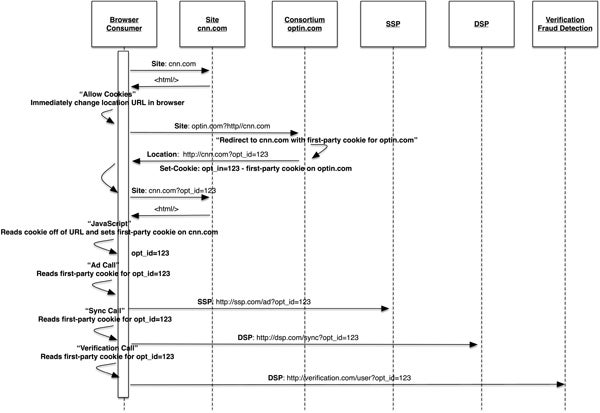
Let’s say I browse to cnn.com, receive a prompt to allow cookies, and I hit “Allow.” If the consent platform took the “cnn.com” location in the browser and reset the location to point to “optin.com?url=http://cnn.com,” it would allow a first-party cookie to be set on “optin.com.” If optin.com would immediately redirect back with “http://cnn.com?optin_id=123,” it would allow for the first-party cookie to be read off of the URL set on “cnn.com” with the key of “opt_in” and the value of 123.
This technical workflow would allow for subsequent calls, if they had JavaScript on cnn.com to query for “opt_in” and pass the value to ad platforms on the URL, along with any metadata appended as a query string parameter to reenable targeting and cross-site tracking. The redirect in this use case, after you hit “Allow,” would give back the same ID on “optin.com” any time the consumer allows cookies for tracking.
Click here to enlarge graphic.
For this to work, standards and specifications will be paramount, and the IAB must play a crucial role in standardizing the first-party cookie workflow outlined above. For example, we would need the key for the first-party cookie to retain a unique standardized name so that platforms that are interested in passing the ID (opt_id=123) know what key to query on the first-party cookie.
An open consortium would also be needed to manage and own the “optin.com” domain, the services required to apply the redirect and the open-sourced JavaScript to set first-party cookies off of the URL to later be queried by other platforms.
The aforementioned workflow would only activate after hitting “Allow Cookies” on a consent platform. As you can see, the ecosystem would share the same ID when targeting and tracking, granting the consumer more control over consent and providing the road map for a safer consumer experience.
There will always be a workaround to track the consumer. While the industry is fretting about the death of the third-party cookie, the real problem is not a technical one. The issue remains what we are legally able to collect on the consumer while adhering to evolving standards surrounding consent and privacy.
We should also be looking at the data that Facebook and Google are collecting. In-home devices, Gmail, Google Documents, Google Maps, Search and Google Apps are all collecting data on a first-party basis, and killing the third-party cookie will do absolutely nothing to stop them from collecting data and monopolizing the advertising market. In fact, it’s empowered their initiatives.
I’m optimistic about the long-term opportunities that this change heralds. The third-party cookie was messy for reasons not related to privacy. Though Google and other industry giants have given themselves an advantage, this change will spur the rest of the industry to innovate, creating new solutions to compensate for the changing environment. The death of the third-party cookie truly empowers us all to come together and build a seamless environment that adheres to privacy controls managed by one ID that represents a consumer and their consent.
March 10, 2020

Third Party Cookie Dead? Now what

As the cookie collapses and regulation chokes the digital ecosystem, brands need to plan ahead


The crumbling cookie, the privacy protection push, the rising regulations – digital marketing ecosystem is witnessing an age of upheaval.

The woke global consumer, aided by regulations such as GDPR and CCPA, wants the control back. Tracking consent, opt-in, opt-out, right to be forgotten and the list goes on… Suddenly, the usually very proactive data and digital ecosystem has gone into a reaction mode. Tech giants and data providers are revisiting their data policies and brands struggling to ensure compliance of their existing tech stacks.

As always, India is never far behind in following the trends. The implications of changes brought about by the global tech providers are already being felt. That coupled with our homegrown PDP (Personal Data Protection Bill) necessitates brands and marketers to sit up and notice. But before we throw the baby out with the bathwater, the question is – Will India be a different story?

Yes, it will be. Sometimes, not being as evolved as the western world is a boon in disguise. India by and large is still in its infancy when it comes to data driven marketing. Other than the large global brands with centralized data and tech infrastructure, the rest can be counted on fingers quite literally. Therefore, unlike the evolved markets we don’t have to go back to the drawing board and reinvent completely. We can simply plan ahead and change trajectory.

So how can Indian brands plan ahead and change trajectory? Is there a ready reckoner so far? Unfortunately, there is a lot of jargon doing rounds that overwhelms and confuses rather than help. At GroupM Motivator, we believe in simplifying the complex for emerging brands. Here are the key implications that Indian brands need to be aware of and plan for.

1. The Strengthening Of The Walled Gardens – There was a time when data driven marketing meant breaking down of the silos. Today the scenario stands reversed. The need to be compliant is driving the giants such as Google, Facebook and several other large publisher networks to further strengthen the walls. The implication is not just for cross platform media buying, tracking and optimizing, but for brands wanting to invest in tech stacks as well.

2. The Break In Attribution Journey – The single view of consumer and end to end digital consumer journey attribution will become a distant reality. The walled gardens and the demise of the cookie will make it increasingly difficult in a cross platform, cross screen environment. Therefore, marketers need to be very wary of promising El dorado.

3. The Deepening Divide By Publisher Size – The bigger publishers and networks with massive own data and ability to target intelligently will benefit, at least in the short term. On the other hand, the value of inventory from smaller publishers will go down. This will in turn impact the brand’s media mix and money outflow by network.
Needless to say, a few of the above may be short term and will be overcome as the ecosystem finds stable alternatives. While that happens, brands will have to plan ahead. Here are the imperatives that are likely to shape the future of digital marketing.

4. The Rise Of Owned Assets – Sadly, most brands in India are underleveraging their own media massively. While the websites exist, the core objective currently doesn’t go beyond information dissemination and landing traffic from paid media campaigns. Now with first party data becoming the most valid, compliant data available to brands, the owned assets will rise to power. The brand website are the new data farming hubs. However, in order to truly leverage the power of owned media, brands need to invest in both a compelling UI/UX and interactive triggers for consumers to leave behind data in exchange of value of some kind.

5. The Consolidation Of The Stack – As walls become stronger and compliance becomes a key concern, brands will tend to make safer choices. It will increasingly make more sense for brands to invest in stacks from a single technology provider rather than customize a mixed bag.

6. The Resurgence Of Digital Creative – The heightened focus on performance and targeting had gradually led to digital creative becoming an ancillary service in digital marketing. Now is the time for creativity to make a comeback. There are two clear implications visible.

a. With limited opportunities to reach the intended TG through paid efficiently, brands will have to find ways to bring the TG to the communication. The onus of giving organic legs to the brand communication will again have to be shouldered by compelling creative and content.

b. For targetable audiences, to make best use of data, the focus on non-intrusive customization will go up. These seem like chaotic times for the digital media industry. But as they say, every wave of new technology that changes the world is followed by regulation. Time for brands to ride the wave and emerge winners.